Showing posts with label information technology. Show all posts

Wednesday, January 14, 2015

Perspectives on the Future of Healthcare and IT.. a Video Interview

I was recently "Video-interviewed" about my thoughts on the future of healthcare and IT.  These types of interviews are usually quick - two questions, five minutes... hopefully some value!  Here are my two questions and a summary of my answers:

Where is the healthcare industry headed?
I believe healthcare is currently a runaway train with an unsustainable model.  But there is hope if we can adapt reimbursement models to incentivize value over volume, and use HIT to simplif, automate and delegate all the care that needs to be done.  With respect to HIT, since over 80% of physicians have an EMR in place, we now an infrastructure or platform on which to build "EMR Extender Tools" which allow for better EMR functionality, efficiency, and effectiveness.  Furthermore, we need to focus HIT efforts on Population Health, Virtual care, and Workflow Efficiency to meet the increasing demands for care that are upon us.  With respect to population health; ACOs and other types of volume-based to value-based reimbursement changes will make it easier and financially viable to really manage the health population well - but we need the right HIT tools to risk stratify the population and then manage them more easily.  Meanwhile, we should see a rapid expansion of virtual care as technologies and demand sync up. Lastly, as physicians (and staff) are burning out quickly, using HIT to create workflow efficiency by simplifying, automating delegating care, is vital to the performance of doctors, as well as the health of patients (which is why I helped found healthfinch to build software solutions that allow medical groups to redesign care more efficiently and effectively). 

What is an HIT Innovation you would like to see happen soon?
I think we are getting closer and closer to “ubiquitous monitoring.” Wearable devices are available, but right now these are often just used by the “healthy and wealthy.” Although this is a good starting point, there is a need to develop patient monitoring tools that are fully ubiquitous - so that collecting biometric data becomes a simple byproduct of everyday life.  These may start as being embedded in smart phones, and now we are seeing them woven into in clothes, but soon we will have watches, patches and even injected nanotechnologies. As these evolve, doctors will be able to receive regular, real-time monitoring of their patients. From there, one can feed data into a rules engine to notify doctors (or even patients themselves) if something is medically wrong. This portends a fantastic future for remote monitoring so that doctors do not have to rely on patients to manually input data all the time and wait for them to come into the office to explain there is a problem.


Saturday, February 02, 2013

The Healing Edge: At the Intersection of Innovation and HIT


Three years ago I was asked by Marion Ball, EdD (a well respected informaticist and long-time colleague) to write a book about the intersection of healthcare IT and innovation.  I was smart enough to initially say no, but she kept asking because she knew I had been combining my long background in informatics with a newer interest in the science of innovation as part of the Szollosi Healthcare Innovation Program, a charitable organization I established in 2007 with a mission to use creative thinking and diverse technologies to produce a better healthcare experience for patients, physicians and others associated with their care.  

After about 6 months I finally accepted the challenge, realizing that since I was an early pioneer in this world of HIT meets innovation - I might as well try and give the area a good book.   I was wise enough to quickly get a partner in this endeavor, the amazing Chris McCarthy, MPH, MBA.  Chris is a friend and my #1 innovation mentor, as well as the Director of the Innovation Learning Network and an Innovation Specialist with Kaiser Permanente’s Innovation Consultancy.  We liked the idea of storytelling and wanted to make the book an enjoyable read about the many awesome healthcare innovators who have used IT to make the healthcare system better, faster and/or cheaper.  We also realized that it would make sense to truly hear the "voice of the innovators" by having them each write their own stories within the framework we created.

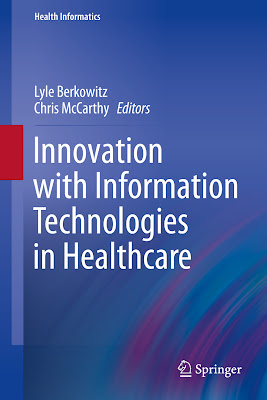
The result is our book, Innovation with Information Technology in Healthcare, which describes the stories of over 20 organizations who have combined innovative thinking with information technologies to improve their processes of care and solve a need at their organizations.

The first chapter sets the stage, describing how this work should be viewed like a big cookbook of recipes, with sections on EMR Innovation, Telehealth Innovation, and Advanced Technology Innovation (e.g. analytics, portals, mobile and gaming).  The second chapter describes the science of innovation itself, including an assortment of methodologies which help move the innovation process from ideation to prototyping/piloting to spreading it across an organization.  The authors, from Kaiser's Innovation Consultancy, give examples from the very real work they have done over the past decade.

The rest of the chapters are the stories, written by the innovators themselves, about what they did, why they did it, how they succeeded, lessons learned, and their plans for the future.   It is especially fun to read about the origins of these innovations and peer into how an organization moves from a problem to an innovative new way of doing things. I wrote a short editorial on the "Big Lessons Learned" from these stories, including the following ideas:
  • Use What You Have:  Our first group of stories highlights how a lot of innovation can be made with the underlying HIT you already have in place, especially EMRs.  Examples include use of messaging to support care coordination, CDS tools to support delegation of preventive care and other duties to staff, and reporting tool to identify adverse events.
  • Innovation is More Than Technology.  For innovations to succeed, it's critical to also address culture issues, new business models, legal and political hurdles, and process change.  And, of course, it's often a good idea to be innovative in doing so!  The stories about telehealth give some great examples of this!
  • Look Around.  Learn from all the new technologies and companies appearing in every aspect of our life... from mobile apps to business intelligence to RFID tools to gaming systems.  The final section on Advanced Technologies provides many examples of this rule. 
  • Dream Big (and Wild)!  We all are faced with problems in our healthcare organizations, and while sometimes the answer is a small improvement in what we do, in other cases we truly need to innovate - to rethink how we do everything and at that time it's important to come up with wild and crazy ideas which can really make a difference.  Don't worry, there will be time later to mix in reality and pragmatism - but in brainstorming, don't be afraid to dream big!  

Finally, it's important to understand that we don't expect readers to follow the exact "recipes" in the book, but rather to be inspired and educated to innovate themselves!  Ideally, you will see what others have done and find the "essential innovation" in each story and be able to apply that to your organization.  It is truly meant to serve as both an educational platform for stimulating ideas in any organization, as well as an inspirational read to help you realize that you too can innovate.  Whether you are a CEO, a CIO, a department head, a clinic manager, a physician, a nurse, an empowered patient, an EHR vendor, an HIT consultant, or anyone else involved in the healthcare system, we hope this book helps you in your quest for The Healing Edge!

Reviews, Editorials, Interviews, Webinars...

Sunday, January 06, 2013

We Don’t Have a Shortage of PCPs, We Have a Shortage of Using Them Efficiently

I've been asked to serve as the "Innovator-at-Large" (aka Editor-at-Large) for the magazine "Clinical Innovation and Technology"... which I was happy to accept as it's the perfect intersection of my worlds!.   In my first post, I've expanded on a phrase I've been using for several years - that "We Don’t Have a Shortage of PCPs, We Have a Shortage of Using Them Efficiently".   I go on to describe the future of healthcare in a world where innovation and IT are being used to their potential to make life easier for physicians and better for patients (of course assuming our reimbursement system equally evolves).  I hope it inspires you!

We Don’t Have a Shortage of PCPs, We Have a Shortage of Using Them Efficiently

Every few months another study warns of a severe shortage of primary care physicians (PCPs) in the future. A recent report published in the Annals of Family Medicine explained how we will require 52,000 more PCPs by 2025 due to population growth, aging demographics and insurance expansion (Reference: 1. Ann Fam Med  2012;10(6):503-509).

Fortunately, both clinical IT and innovation will deeply change medicine over the next decade, resulting in a new paradigm with the potential to improve both efficiency and quality of care. In this paradigm, software will be able to automate or delegate much of the routine care usually provided by physicians. If automated systems and empowered staff members manage stable patients according to evidence-based protocols, physicians can focus on more complex patients who truly require their attention. Individual physicians will actually see fewer patients, but oversee a team who will care for more patients. Thus, we won’t need more physicians; we will just need a better system to help most appropriately leverage physicians, staff and IT.

A typical physician’s office in 2025 might look something like this: Dr. Blake Willoca arrives around 9a.m. and sits in front of a bank of computers and video screens. Dashboards provide real-time analysis of the status of his panel of 5,000 patients. Patients in the Green Zone will be managed mainly by computerized systems which check on patients virtually to provide positive feedback and ensure they stay on track. Meanwhile, patients in the Yellow Zone will be visited by the physician’s care team at home or work, or perhaps have a virtual conference with the physician to answer their questions. Finally, those patients in the Red Zone will be seen in the office or home for longer sessions with the physician and his or her care team to help determine what is going on and how to get it under control. Today, Dr. Willoca will spend an hour with each of these four Red Zone patients in his office, he will do five-minute video conferences with staff members taking care of 20 Yellow Zone patients, and he will spend some time in a virtual reality game teaching med students about how this new system works. As Dr. Willoca leaves his office at 5p.m., he knows he’s helped the patients who most needed it today in a relaxed and livable manner, and he knows that his IT tools and care teams will continue to monitor and help manage his patients 24 hours a day.   

This might all seem like a PCP’s dream, but we need to recognize and accept that we are the generation who will make this happen. There is much to do in healthcare, and there could not be two greater tools to use than clinical innovation and IT.

Online at http://www.clinical-innovation.com/topics/practice-management/we-don%E2%80%99t-have-shortage-pcps-we-have-shortage-using-them-efficiently

ADDENDUM
As questions come up on this article and topic, I'll make sure to post answers here.

* Barriers: Someone asked why we don't see more of this type of attitude from doctors?  My answer: I think there are two main barriers we need to overcome to increase the spread of this type of "team-based CDS" which automates and delegates clinical work:  First, we need to continue to better align incentives (i.e. Value-based vs. Volume-based reimbursement and legal systems)... How can we expect doctors to delegate work if they are not protected financially or legally from doing just that?  Second, we need to make CDS easy and intuitive to use and ideally integrate them fully and elegantly into our EMR systems (see examples below of companies working on these types of tools).

* Speed: Someone asked why this can't happen sooner (i.e. why did I say 2025 instead of 2015).  It's a good point, as I think it is technically feasible today.  I used 2025 because (1) It was the year used in the article I initially quoted about MD deficits, and (2) I did want to describe a future world where this vision of team-based care and HIT would be completely common and routine, not simply possible.  I think there are financial and legal issues which will slow it down, but I also think that we will be seeing more and more of this happening in the near term as well - just not as widespread and pervasive as we'd like for another 10 years or so.

* Risk Stratification: Someone asked how many patients would fall into the Green/Yellow/Red zones.  Studies have shown that 1% of the population accounts for 20 - 30% of the cost, and 5% account for 50%, whereas the healthiest 50% account for just 3% of the total cost.   So I'd suggest the "Red Zone" is about 5% (e.g. 250 patients in a panel size of 5000), the Yellow Zone would be around 20% (1000 in a panel size of 5000), and then the other 75% in the green zone.  Using another way to measure it, today's typical panel size is 2500, which requires a PCP to see about 25 of these patients in a given day.  If the panel size were 5000, the old system would require them to see 50 patients a day.  In the "new" system, I'd suggest they will need to see about 5 "Red Zone" patients a day in the office while interacting with another 20 "Yellow Zone" patients (or answer questions for their staff members) - which could take anywhere between 1-5 minutes.   The reason that this number stays relatively high is that the Red and Yellow patients do need to be actively managed on an ongoing basis - some will eventually move into Green territory, but others simply have too many interacting or unique problems and medications which are beyond the scope of even advanced protocols and is where the cognitive skills of physicians will shine.  Of course, when artificial intelligence gets good enough to figure all these things and how to communicate it all to patients - then we may see even more automation in healthcare... but if/when computers have gotten that good - we will likely see automation in every other professional career as well - from lawyers and judges, to politicians and marketers, to stockbrokers and Venture Capitalists.  In other words, while I agree with Vinod Khosla's assessment that we will see HIT further automating healthcare... I don't think it will "replace 80% of doctors" - but it will allow us to effectively leverage the current amounts of physicians.

Companies Making "Physician Efficiency Apps" (or "Doctor Happiness Tools" as I like to call them)
* healthfinch: A cloud-based decision support system which integrates with EMRs to automate and delegate repeatable work away from physicians and towards their staff in a safe and consistent manner (e.g. Medication Refills).  I founded this company in 2011 with two very smart HIT experts focused on human-centered design, and have mentioned in some past blogs about "Saving Primary Care with Team-based Delegation Software" and another about "EMR Extender Tools creating Doctor Happiness".  The first product, RefillWizard, which integrates with some of the main outpatient EMRs to help decrease the amount of time doctors must spend approving medication renewal requests, saving them up to 30 minutes daily. If we apply that 30 minutes of savings to the 400,000 primary care physicians in the US, we can effectively "create" 25,000 new physicians—half the expected shortfall in physicians caused by population growth, aging demographics and insurance expansion!  Now just create a few more of these and we save the healthcare system!
* healthloop: Automates the "follow-up" process to check on patients after their in-person visits.  Founded by Dr. Jordan Shlain, another of the rare but growing breed of working PCPs who understands how HIT can help make life easier for docs and patients and is building tools to fulfill that vision.

Other Relevant Articles
* Primary Care Physician Shortages Could Be Eliminated Through Use Of Teams, Nonphysicians, And Electronic Communication, Health Affairs, Jan, 2013 (vol. 32, no 1): 11-19.   Says that there will not be a doctor shortage as long as we optimally utilize team-based care and HIT.
* Estimating a reasonable patient panel size for primary care physicians with team-based task delegation.  Altschuler J, Margolius D, Bodenheimer T, Grumbach K. Ann Fam Med. 2012 Sep-Oct;10(5): 396-400. doi: 10.1370/afm.1400.  Estimates how much care can be delegated in a team-based model, and thus what an optimal panel size could be to do perfect care.
* Project Doc Shortage is Real, Experts Say.  Modern Healthcare, Jan, 2012.   Discusses that while team-based care and HIT will improve efficiency, we will still have some need for more PCPs - especially in underserved areas.
* Doctor Shortage Getting Worse.  A CNBC article (Mar 13, 2013) where they use the usual claims (again, based on the current model of care) and I appear to be the "poster doc" for the concept of using IT to improve efficiency and save time.  My section: And one expert says it's not so much a scarcity of physicians but of using them in the right way.  "We don't need more physicians, but rather better "team-based workflow tools" to ensure that everyone on the team can work to the highest level of their ability in a safe and efficient manner every day," said Dr. Lyle Berkowitz, Associate Chief Medical Officer of Innovation for Northwestern Memorial Hospital.  "That means using information technology and freeing physicians to spend their time on more complex patients," Berkowitz added.
* What Doctor Shortage?  Published in Medical Economics (Jan, 2023) - I revisited this topic 10 years after the original post and talk more about the execution of expanding panel size via a combination of technology and virtual team-based care.  This is playing out in real life with my new company  KeyCare (where we provide health systems access to a tech-enabled virtual care workforce practicing on an Epic platform optimized for telehealth).




Monday, January 30, 2012

Care Innovation Summit (Jan 26, 2011 in DC)

I was one of 1200 "healthcare innovators" attending the annual Care Innovation Summit last week, sponsored by CMS, the West Wireless Health Institute, and Health Affairs magazine.  The day started with a fantastic keynote by Atul Gawande, MD, and then there were assorted panels talking about healthcare innovations across the US. 
My thoughts and reflections on the day:

First, it was a good use of time.  It is hugely important to be able to hear innovation stories, and it is important the providers, industry, and government are all sharing with each other and trying to figure out this mess we call a healthcare system.  Additionally, the networking is always fantastic at a place like this.  I was able to see some old friends like Ted Eytan (Physician Innovator and awesome blogger), Margaret Laws (CHCF), and Carleen Hawn (Healthspottr), as well as meet some new friends who do great blogging, like Andre Blackman (Pulse and Signal) and Dr. Joseph Kim (Medicine and Technology).

Second, Gawande's keynote was really great - how can a surgeon be such a good writer and excellent speaker?!?!?  He focused a lot on the importance of creating easier systems which cost less and deliver all the appropriate care to as many people as possible. A few comments he made which stood out:
  • Healthcare Costs are Killing the American Dream.  The "typical" US family has seen almost all of their increase in take home pay in the past decade go to paying for their healthcare costs. 
  • We need Automation and Teamwork.  The complexity of healthcare is increasing exponentially but we have not really altered how we deliver care - one physician at a time.  In the past "2 generations" (about 100 years), we have expanded to over 13,000 known conditions, 6,000 meds, and 4,000 types of procedures - physicians have to know all these and then deliver them to every single American - not exactly efficient (and rarely consistent).   In other words, "We need Pit Crews, not Cowboys".  Every other industry has learned how to automate and task shift… it's time for healthcare to do the same!   [Side note... I think this is so important for the future of healthcare - that it is the basis of a new company I helped create in the past year... more to come later]
  • We need better Data!  I love the analogy he gave… He said, "the way we currently provide data is like driving your car, but when you look at your speedometer, all you see is the speed of other cars from 4 yrs ago." We need to have real time data, specific to our needs!
  • The Best Places Act like Systems.  He noted these three key skills are needed:
    • The ability to recognize Success vs. Failure (i.e. need up-to-date data which is focused on a specific issue).
    • The ability to identify failures and then devise solutions for them… he of course pointed out that you should consider Checklists to help organize the "best care".  I agree!
    •  Make solutions easy to implement.  Keep them simple and cost-effective, and recognize the importance of consistency and teamwork.
Third, the government folks said that they know we have to become more innovative.  Dr. Richard Gilfillan (acting director of the CMS' Center for Medicare and Medicaid Innovation) said, "We need to decide now whether to make the commitment to adopt innovation that will fundamentally change the way we operate, change the way we deliver care, change the way we think about these organizations that we run. This is not an abstract notion; this is a very concrete question that each of us will have to answer."

Marilyn Tavenner (acting administrator for the Centers for Medicare & Medicaid Services) highlighted a variety of innovations, and expressed urgency in pressing forward with the “triple aim” goals of better individual healthcare, better population health and lower costs called for in the health reform law.

As a reminder, the summary of the Healthcare Reform law essentially comes down to four things: 
  • Value: improve quality and cut costs  (and the part that is TOP on the mind of everyone)
  • Access
  • Insurance reform
  • Medicare improvements
And the Triple Aim (as defined by Dr. Berwick) is:
  • Better care (at an individual level) - including the STEEP criteria (Safety, Timeliness, Effectiveness, Efficiency, Equitable, Patient-Centered)
  • Better health (at a population level)
  • Lower costs
CMS also recognizes that the only way to do all this is for government and payors to better align incentives (hence the experimenting with ACOs and other reimbursement changes).  And as Todd Park (CTO for CMS) said, do anything they can to help America's "innovation mojo" heat up to start solving problems (such as by promoting the challenges below). 

Fourth, they released a series of private-backed Challenges throughout the day.  ONC posts these challenges at www.Challenge.gov/ONC.  Here are the ones announced at the Summit:


Fifth, they had a variety of payors, disease management companies and providers talk about "innovative programs".  Health 2.0 blogged on some of these innovators, and here are two that stood out to me:
  • The WellPoint "Care More" model focuses on the 15% of patients which account for 75% of costs.  "Extensivists" work with PCPs to provide early and quick intervention (e.g. patients see the Extensivist clinic a few times a year, in addition to the PCP).  This model also uses a host of other providers as well (e.g. home care, social workers, dietitians...) to create a fabulously deep and rich team for these patients.
  • ChenMed is a provider group which focuses only on complex elderly patients.  Their mantra is "Coordination, Collaboration, Convenience, Compliance".  They succeed because they limit MDs to just 350-400 patients and build a whole system around these patients.  

So while these are both great programs, they also represent the weaknesses in the conference:
  • The majority of presenters focused on Medicare patients - understandable since that is of utmost interest to CMS… but there is much to learn with younger patients too.  Additionally, CMS must realize that poorly controlled younger patients will wind up in their lap eventually!  We have to somehow integrate CMS with the private insurers in some way to keep them both aligned.
  • The majority of presenters said they achieved some quality benefits by focusing a high amount of care on the "most complex 15%" of patients.  On one hand, this is great stuff - and important to learn how they did it so it can be replicated.  On the other hand, it should not come as a shock that expensive heavy lifting on those folks improved outcomes… were these innovations or simply sound logic?  Are they reproducible?  And did they cut costs (e.g. what was the ROI)?  

Additionally, I think a key quote of the day came from Aetna's CMO when describing a program they implemented to help patients after a heart attack. He said, "we gave them free meds after an MI, and compliance was still only 49%!"  So whatever we do we better make sure it is "easier" for patients than their current lives... because behavior change is really hard!!!

And one other great quote came from a nurse who was talking as a patient, knowing she was dying from cancer.  She did her research and chose to not try end-stage treatment that would hurt her quality of life and only possibly give her a small amount of extra time.  She reminded us not to "force" care onto everyone, for as long as someone has been educated, "There are no wrong choices, only informed choices."

Finally, how about some more IT Innovations?
We heard how IT could help collect, analyze and display data… which could be used to find problem areas or identify high risk patients (e.g. predictive modeling).  We even heard how the Archimedes Model can help predict the outcomes of various interventions.  However, we did not hear how IT innovations could allow for better economies of scale (via automation) and easier spread of improved processes.  My theory is that we use IT to help automate the care for the 85% of patients which are "healthy and stable", so that the high touch care for the complex 15% can continue.  I plan to do my best to support companies that fall into either of these buckets!