Showing posts with label healthcare innovation. Show all posts

Sunday, July 12, 2015

Advice to Healthcare Startups

Like many in my role, I am constantly pounded by young entrepreneurs with the "next great innovative idea for healthcare".  I appreciate their energy and enthusiasm, and in some cases they really do have something cool and special.  However, I do find myself repeating many of the same thoughts and "rules" - so I thought that I would put some down on paper to prepare them ahead of time.

This is in part inspired by an GREAT blog by Todd Dunn (Director of Innovation, Intermountain Healthcare Transformation Lab):  The Seven Deadly Healthcare Startup Sins (and his follow up advice).  The summary:
Sin 1: Healthcare startups assume hospitals will let them host patient data in “their portal.”
Sin 2: Startups assume that clinicians will be willing to access yet another portal for their data.
Sin 3: That one doctor or hospital lends enough credibility for other organizations to simply accept a startup’s solution.
Sin 4: Believing that ONE key leader inside a hospital is the decision-maker, influencer, etc. all in one role….
Sin 5: Thinking that conducting a “proof of concept” and/or pilot is a simple endeavor.
Sin 6: There isn’t anyone else out there solving the problem.
Sin 7: Believing that startups need to have more answers than questions.

His Advice:

  • Use the Lean Startup tools! Regardless of where you start, it comes down to your value proposition as a starter or non-starter. 
  • This often tries the patience of entrepreneurs. I cannot overemphasize the need to use the learning loop in every single part of the Value Proposition and Business Model canvases. The only way to do that is to GET OUT OF THE OFFICE!
  • Be curious about workflow  - Be empathetic to your user.
  • Study the industry more deeply. While you may have a great value proposition for one or two hospitals, how does your solution fit into the regulatory landscape, workflow, etc. of multiple hospitals?
  • Listen! Assume you don’t have enough evidence to scale your business yet. Act like you don’t know enough. While an entepreneur’s “go get ’em” attitude is appreciated, it isn’t appreciated when the entrepreneur isn’t open to feedback, seems to have all the answers, and has a condescending attitude toward the way “jobs” get done today. Test your assumptions! Come loaded with questions that are related to your assumptions.
  • Last but not least, structure a learning plan. Embrace the Lean Startup tools and methods. Following this structure will cause you to write a learning plan. A foundational question to guide your learning plan in every part of your business model is “What do we need to learn before we invest more time and money?”

Some thoughts and Rules I would add to enhance the above

  • There are basically no new ideas... a successful startup understands it is about execution.  So please don't tell me that you have a brand new idea and want an NDA because the idea is so priceless and if anyone else finds out about it they will copy it.  If it's that easy to replicate, then you really don't have a business.  I remember years ago when I was being mentored by the great informaticist Dr. Bob Greenes.  He took me into his office and showed my his PhD thesis from around 1966.  This was the dawn of the age of computers, and in his thesis was basically every idea we are now hearing from "startup" companies daily - computer guided interviews and diagnosis, telemedicine, artificial intelligence to read notes, etc...   The key is rarely the idea, but how you combine the right people with the right technology and the right timing to make it all work.  Bill Gross had a nice Ted Talk on the topic of "The Single Biggest Reason Startups Succeed".  So convince me you really understand a problem and solution well and that you can be THE company that executes on it better, faster, cheaper than anyone else!
  • Truly understand and be able to explain your "Value Proposition" - specifically, clarify (1) Who Pays for your tool, (2) Who Uses your tool, and (3) Who Benefits from your tool.  In healthcare, the incentives are often not aligned - and the smart startup will fully understand and have a business plan that makes sense.  Nothing turns me off quicker than a company that expects a doctor to pay for and use a tool, when all the financial benefit then accrues to another party.  
  • Bring me a solution, not just a tool.  A lot of startups are talking about how they use "big data" to identify problems and opportunities for improvement.  That is nice, but the truth is we have a lot of low hanging fruit in healthcare- I don't need to find more problems as much as I need solutions.  So if all you are selling is a way to find more problems, that will not resonate as well as a packaged solution that also "fixes" them.   For example, the analytics vendor  HealthCatalyst is soaring because they realized that they need to use analytics to identify both the problem and the potential solutions to be successful.  Another interesting company, Transfuse Solutions, combines analytics and process improvement techniques to focus on the specific issue of identifying when a hospital is doing too many transfusions and then offering solutions on how to improve on those metrics. 
  • Be committed... healthcare is not for the faint of heart.  This is a big business, with long sales times, difficult implementations and hard change management.  When something works and can improve efficiency, quality and financials at the same time - and can scale well... then you will have a winner, but nothing happens overnight like in so many other industries.  So don't tell me how you have a part-time CEO, and you are out-sourcing all your IT work so some guys who have other jobs.  That is not going to build a company which has the DNA needed to succeed in this industry - show me executives and staff that wake up every day obsessed with fixing a specific problem, and an IT team that understands the nuances of healthcare and can react quickly to solve issues. 
  • Make it easy to do the right thing, especially if this is doctor facing.  I often say that the best healthcare IT can make life easier for doctors and better for patients at the same time.  Do not try and tell me how "this system only asks the doctor to spend one more minute for each patient" - we don't have one extra minute!   We want you to tell us how you save us time from mundane tasks so we can have more face to face time with patients - that is what will win our hearts and minds!   This post from last year explains this thinking further: http://drlyle.blogspot.com/2014/11/the-three-keys-to-solving-our.html
So yes, please keep innovating and trying to make things better.  Our current healthcare system is clearly not sustainable as it stands, making for a "target rich environment".  But when pitching to busy providers and healthcare organizations, remember that their plate if often very full - so have your value high, your proponents lined up, your story straight, and your team ready to truly make a difference in the lives of both providers and patients.


Addendum: List of Other Relevant Blogs and Advice for Startup Entrepreneurs

Monday, November 10, 2014

Hacking to Innovate and Engage: Why Hackathons Will Change Healthcare for the Better

In today’s post-reform world, we hear time and time again that there is (or soon will be) a physician shortage due to a variety of factors.  For example, with the millions of people who now have access to healthcare services due to the Affordable Care Act and the growing aging population (with their increased risks and needs) – it’s no surprise a potential physician shortage is a regularly addressed topic.  However, I still strongly believe that we do not have a shortage of physicians, just a shortage of using physicians efficiently (see past blog).

As a PCP who has been taking care of patients for over two decades, I know firsthand that the amount of hours in a day is never enough to accommodate all we want to do (we often get caught up in fire drills, and can't get to all the preventive and chronic care management we would ideally address).  Fortunately, I do believe that by combining technology, innovation and teamwork, the potential to simplify, automate and delegate care for a more efficient care delivery process exists, even if it’s not always easy to accomplish.

In this blog, I want to touch on what some consider a surprising way to simplify the equation and make better use of physicians and their limited time: A motivated and engaged patient. Care coordination can be achieved when patients and physicians are aligned throughout the care continuum, creating a more succinct care delivery process. Studies show an empowered patient can lead to better outcomes – and potentially lower costs – so the better we are at equipping patients with the proper care plan, the more we can alleviate some of the burden providers face caring for nearly 20 patients per day.

I recently participated in the Intel-GE Care Innovations Patient Engagement Hackfest as the closing keynote speaker and a judge. The purpose of the event was to solve one of the biggest hurdles in healthcare today: connecting patients to their health and healthcare providers through better engagement. Not an easy feat. The major challenges I see are: 
  •          Behavior change is hard
  •          Incentives are misaligned
  •          Information overload
  •         Patients spend most of their time outside of the office or hospital setting

 That last point may be the most important to any physician out there. The disconnect is real, and the ability to influence overall health is limited. So how do we – healthcare leaders, physicians, innovators and disrupters alike – continue to push the envelope further for a more connected healthcare system? In writing a book on the intersection of HIT and Innovation, I found some pretty consistent themes on how to innovate in a healthcare environment, which I would summarize as follows: 
  •          Have a champion with passion and knowledge
  •          Listen to and observe the front line
  •          Start with crazy, out of the box ideas, then make them realistic
  •          Fail Fast, Fail Small, Fail Cheap
  •          Figure out a sustainable business plan
  •          Spread your idea with the IT systems in place

Hackathons incorporate many of these concepts in a tightly focused and concentrated manner. They are a fertile ground for giving life to innovative concepts and inspiring people to develop healthcare’s next generation of solutions. The Intel-GE Care Innovations Patient Engagement Hackfest brought together passionate and inspiring people – from entrepreneurs to programmers to clinicians – who shared ideas and resources to make the patient the most important part of the care team. And that’s a worthy cause to get behind.


Be on the lookout for a hackathon near you! 

Sunday, August 18, 2013

Defining Healthcare Innovation

In my recent post at Clinical Innovation + Technology, I tackled the issue of defining "Healthcare Innovation".  I decided to do it by answering the typical questions I often hear, and so hope this helps you in explaining to others!  Below are my answers, with a bonus answer for my blog :)

One of the most common questions asked these days is “What is healthcare innovation?” Like the story of the blind men touching different sides of an elephant and each describing something separate, you will hear a wide variety of answers to this question based on whom you ask.
The following is a way to address the common questions on this topic so you can start organizing innovation in your mind and within your organization.
First, should the focus of innovation be on innovative information technologies, devices, workflow processes, care models or business models? Obviously, it can be any or all of the above. In the past, it is fair to say the majority of innovation work was in the devices arena since there was a clear financial return to the organization if a new device was widely adopted.  However, in a world changing to value-based reimbursement, we are seeing that process and care model innovations will likely be leading the charge, with information technology being an enabler of those innovations.
Second, how is an innovation project different than an improvement project? The short answer is that an improvement project is done to improve something, while an innovation project is done to blow up the current process or tool and create a new one. A classic example of this is polio: improvement experts would focus on designing a better iron lung, while innovation experts would consider how they might create a vaccine to stop this disease in the first place.
Third, is there a science or methodology to doing innovation well? Yes, similar to how improvement projects may use techniques like Lean and Six Sigma, the world of innovation relies on the concept of “Design Thinking” which has a different set of methodologies. The typical innovation project involves three main phases: discovery, incubation and acceleration. In the discovery phase, a problem is studied and observed and then various brainstorming techniques are used to create potential solutions. In the incubation stage, rapid cycle prototyping and piloting are done to quickly and cheaply find what fails and what works. In the acceleration phase, the successful pilot is spread using a variety of educational and other techniques.
Fourth, do all innovators need to use this formal science of innovation to succeed? It’s fair to say that many of the innovations we see in healthcare were done without formal innovation methods.  Rather, innovation started with a passionate individual or team trying to solve a problem with which they had a deep understanding. They would try various iterations until they got something that worked and then maybe spread it to others. However, the creation of an innovation culture and infrastructure to support a formal process of design thinking is likely to help identify more of these projects and make them more successful.
Fifth, what helps make up a successful healthcare innovation? First, it always starts with a passion for making something better plus some time and resources to focus on the project.  Second, it needs to have a real-world business model to keep the innovation sustainable. Third, the innovation needs to be well integrated into information technologies and clinical workflows so that it can be easily spread. Not surprisingly, it is this last part which is always one of the hardest and yet most important pieces. And it is why this intersection of information technology and innovation remains critical to the success of evolving our healthcare system to meet its potential.
Bonus question: What is the difference between a sustainable and a disruptive innovation? Sustainable innovations are those which sustain the current business model (e.g. things that promote volume in a FFS environment) and/or which add on features/functions with an increasing cost (e.g. the new MRI machine). Disruptive innovations are going to change the business model, often by offering same or less features, but at a much lower cost (e.g. TeleDerm visits, Nurse-managed protocols for Diabetics, a hand-held cardiac ultrasound which gives you just the heart information you need to make a clinical decision).  A recent article from the Clay Christenson Institute reviews Why EHRs are Not (yet) Disruptive.

Clinical Innovation & Technology Article Link: Defining Healthcare Innovation

Monday, July 01, 2013

The Hat Trick: Physician + Informatics + Innovation

Looks like June is Q&A month for me!
Here are three recent interviews and articles where I answer questions about Healthcare IT and Innovation:

When Health IT Meets Innovation: Q&A With Dr. Lyle Berkowitz of Northwestern Memorial Hospital (Becker's Hospital Review)
This interview focuses on lessons learned from my book (Innovation with Information Technology in Healthcare) - so I review the history of the book, mention a few of the stories, discuss the biggest "takeaway" (get inspired by others, but modify innovations for your own organization), and explain how to start innovating right now!

5 Questions For… Dr. Lyle Berkowitz (The Intel Health Blog)
This interview is more broad-based and we talk about how to change an organization's culture towards innovation, more lessons learned from my book, where healthcare innovation is heading in the coming years, and What is the Szollosi Healthcare Innovation Program.

The Hat Trick: Physician + Informatics + Innovation (Clinical Innovation and Technology)
This is my monthly article as "Innovator in Chief", and I talk about one of the most common questions I am asked - how to balance clinical care, informatics and innovation.  Full text is below:

I am a practicing physician with extra responsibility for informatics and innovation. I love being able to do multiple things in my day, but I do often hear “How do you juggle all those roles?”  The simple answer is that I truly treat them as synergistic—they feed and support each other. My first love is being a primary care physician and taking care of my patients. Yet I also am constantly thinking about how I might do my job easier and better.
Sometimes there is an informatics answer, such as creating new content, alerts or reports within our EMR. Other times there are more innovative answers, such as creating a new process which helps delegate work across my team. But increasingly, there is a combined answer, such as creating a new workflow within our EMR or finding an innovative IT tool and figuring out how it fits into our system’s infrastructure.
Physician informaticists also ask me is how they can be more innovative. The good news is that most informatics doctors are perfectly set up to expand into the innovation space. They already have an appropriate skill set, such as an interest in new technologies and workflows, excellent problem-solving talents, an ability to work with a wide range of personnel, and an innate desire to constantly improve the current system. The trick is whether they have the time and resources to make these changes happen, so here are some thoughts to help you blaze this trail at your organization.
First, start small and let things evolve. In fact, a well-known innovation mantra is “Fail Fast, Fail Cheap, and Fail Often.” In other words, you should embrace piloting and the concept of an “n of 1,” often where you can and should be your own guinea pig and ground zero for your innovations. This means signing up for the many new apps, websites and technologies you see out there, healthcare related or not. Try them all for a little to see what they feel like and think about how they might apply to healthcare. Maybe come back to them at another time if you don’t see the value at first. Be the first to try new EMR functions to determine how well they might work in your system’s current workflow, or if they warrant a new workflow.
You will fail. A lot. That is okay, because each mistake is a golden piece of information which will help lead you to a better place. By starting small, you don’t need a lot of time, resources or permission to try something new.
Second, always make time to observe. Just watching your colleagues and staff in their day to day lives will help you quickly see bottlenecks and gaps. For example, I was approached by our hospital nursing executives recently as they were trying to be innovative with the discharge process. We formed two teams of three people each and went to the floors to observe and talk to the frontline staff—the nurses and other caregivers on the floor. We used a classic innovation method called “Love/Wish,” where we ask folks what they love about a process and what they wish would change to make it better. An hour later our two groups met and found we had a robust list of opportunities that involved improvements and innovations to both workflow and IT utilization.  
Being a physician informaticist gives you a unique platform upon which to innovate, so keep your eyes and mind open and help make a better system for all of us.

Saturday, February 02, 2013

The Healing Edge: At the Intersection of Innovation and HIT


Three years ago I was asked by Marion Ball, EdD (a well respected informaticist and long-time colleague) to write a book about the intersection of healthcare IT and innovation.  I was smart enough to initially say no, but she kept asking because she knew I had been combining my long background in informatics with a newer interest in the science of innovation as part of the Szollosi Healthcare Innovation Program, a charitable organization I established in 2007 with a mission to use creative thinking and diverse technologies to produce a better healthcare experience for patients, physicians and others associated with their care.  

After about 6 months I finally accepted the challenge, realizing that since I was an early pioneer in this world of HIT meets innovation - I might as well try and give the area a good book.   I was wise enough to quickly get a partner in this endeavor, the amazing Chris McCarthy, MPH, MBA.  Chris is a friend and my #1 innovation mentor, as well as the Director of the Innovation Learning Network and an Innovation Specialist with Kaiser Permanente’s Innovation Consultancy.  We liked the idea of storytelling and wanted to make the book an enjoyable read about the many awesome healthcare innovators who have used IT to make the healthcare system better, faster and/or cheaper.  We also realized that it would make sense to truly hear the "voice of the innovators" by having them each write their own stories within the framework we created.

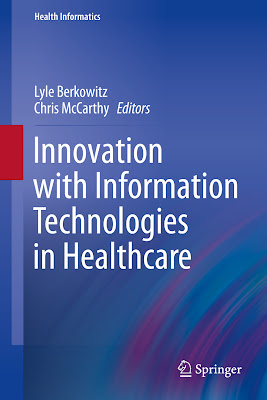
The result is our book, Innovation with Information Technology in Healthcare, which describes the stories of over 20 organizations who have combined innovative thinking with information technologies to improve their processes of care and solve a need at their organizations.

The first chapter sets the stage, describing how this work should be viewed like a big cookbook of recipes, with sections on EMR Innovation, Telehealth Innovation, and Advanced Technology Innovation (e.g. analytics, portals, mobile and gaming).  The second chapter describes the science of innovation itself, including an assortment of methodologies which help move the innovation process from ideation to prototyping/piloting to spreading it across an organization.  The authors, from Kaiser's Innovation Consultancy, give examples from the very real work they have done over the past decade.

The rest of the chapters are the stories, written by the innovators themselves, about what they did, why they did it, how they succeeded, lessons learned, and their plans for the future.   It is especially fun to read about the origins of these innovations and peer into how an organization moves from a problem to an innovative new way of doing things. I wrote a short editorial on the "Big Lessons Learned" from these stories, including the following ideas:
  • Use What You Have:  Our first group of stories highlights how a lot of innovation can be made with the underlying HIT you already have in place, especially EMRs.  Examples include use of messaging to support care coordination, CDS tools to support delegation of preventive care and other duties to staff, and reporting tool to identify adverse events.
  • Innovation is More Than Technology.  For innovations to succeed, it's critical to also address culture issues, new business models, legal and political hurdles, and process change.  And, of course, it's often a good idea to be innovative in doing so!  The stories about telehealth give some great examples of this!
  • Look Around.  Learn from all the new technologies and companies appearing in every aspect of our life... from mobile apps to business intelligence to RFID tools to gaming systems.  The final section on Advanced Technologies provides many examples of this rule. 
  • Dream Big (and Wild)!  We all are faced with problems in our healthcare organizations, and while sometimes the answer is a small improvement in what we do, in other cases we truly need to innovate - to rethink how we do everything and at that time it's important to come up with wild and crazy ideas which can really make a difference.  Don't worry, there will be time later to mix in reality and pragmatism - but in brainstorming, don't be afraid to dream big!  

Finally, it's important to understand that we don't expect readers to follow the exact "recipes" in the book, but rather to be inspired and educated to innovate themselves!  Ideally, you will see what others have done and find the "essential innovation" in each story and be able to apply that to your organization.  It is truly meant to serve as both an educational platform for stimulating ideas in any organization, as well as an inspirational read to help you realize that you too can innovate.  Whether you are a CEO, a CIO, a department head, a clinic manager, a physician, a nurse, an empowered patient, an EHR vendor, an HIT consultant, or anyone else involved in the healthcare system, we hope this book helps you in your quest for The Healing Edge!

Reviews, Editorials, Interviews, Webinars...

Sunday, July 08, 2012

Dr. Larry Weed is The Oracle: Medical Records Should Guide and Teach!

Dr. Larry Weed was an amazing visionary physician.  Let me start by summarizing what he started saying in the 1960s:  "We need to better organize our records, better utilize paramedical personnel and appropriately use computers" - over 40 years later, and we still haven't followed his advice very well!  But we know it's true more than ever now, and we better start moving in that direction quickly!

Thanks to the internet, much of his original work exists, and it should be mandatory reading (and viewing) by anyone developing healthcare IT software or trying to change the system in any way.  Here are some of his papers:

  • Medical Records that Guide and Teach: His original 1968 paper in the NEJM explained the Problem-Oriented Medical Record (POMR) - which has since become the standard of documentation across the globe.   NOTE: Unfortunately, this system has often been incorrectly thought to mean the whole note should be in SOAP format (Subjective, Objective, Assessment, Plan) vs. having a SOAP component for each individual problem.  The result is that many notes are harder to create and read since they don't group relevant information together.  
  • Managing Medicine: His 1983 book which: "Contains the best of previously-published materials on Problem-Oriented Medical Records, and explains the Knowledge Couplers which have occupied Dr. Weed up to the year 2000. Much of this material is transcribed from lectures and conversations, so it preserves the candid tone, energy, and eloquence of Dr. Weed that can usually only be experienced in person or on videotape. Illustrated, with highlights captioned throughout." (per Amazon description).
  • Interview with Dr. Weed: A 2009 article written by a former student who says, "We discussed when he first was alerted to the nonscientific approach clinicians use to make decisions on patients. The rest of the interview time was spent with Dr Weed teaching me about the solution that he has spent the last 30 years designing and implementing."
  • Medicine in Denial (2011) According to Dr. George Lundberg's commentary, "In 267 pages, they sharply dissect virtually every sphere of medical education and medical practice. The tenet is familiar; the need to couple patient data with medical knowledge. This is not just a critical rant; it is a detailed "how to" fix the broken system.  Specifics such as "Changing medical education from a knowledge-based to a skills-based approach" and "Information processing, clinical judgment, and the two stages of decision-making" are good examples of the original 1970s premise still awaiting mass application in this century."  You can get a PDF overview here.
  • Other: "Medical Records, Patient Care and Medical Education" (1964), his first paper on the topic, and in a later paper he explains, "The Problem-Oriented System, Problem-Knowledge Coupling, and Clinical Decision Making" (1989).

Finally, I especially enjoyed this video of his 1971 Grand Rounds at Emory University (see below).  Some key takeaways from his presentation include:

  • Physicians need to be guidance systems, not oracles.  
  • The medical record provides the data needed to be a successful guidance system, and is critical for the best Education, Care and Research. 
  • Every patient and their problems are unique - just like there are 88 keys on the piano, but millions of symphonies can be played.  
  • Treating a sick patient is like a Chess game... you make your move, Nature plays her move, and then back to you.


Monday, January 30, 2012

Care Innovation Summit (Jan 26, 2011 in DC)

I was one of 1200 "healthcare innovators" attending the annual Care Innovation Summit last week, sponsored by CMS, the West Wireless Health Institute, and Health Affairs magazine.  The day started with a fantastic keynote by Atul Gawande, MD, and then there were assorted panels talking about healthcare innovations across the US. 
My thoughts and reflections on the day:

First, it was a good use of time.  It is hugely important to be able to hear innovation stories, and it is important the providers, industry, and government are all sharing with each other and trying to figure out this mess we call a healthcare system.  Additionally, the networking is always fantastic at a place like this.  I was able to see some old friends like Ted Eytan (Physician Innovator and awesome blogger), Margaret Laws (CHCF), and Carleen Hawn (Healthspottr), as well as meet some new friends who do great blogging, like Andre Blackman (Pulse and Signal) and Dr. Joseph Kim (Medicine and Technology).

Second, Gawande's keynote was really great - how can a surgeon be such a good writer and excellent speaker?!?!?  He focused a lot on the importance of creating easier systems which cost less and deliver all the appropriate care to as many people as possible. A few comments he made which stood out:
  • Healthcare Costs are Killing the American Dream.  The "typical" US family has seen almost all of their increase in take home pay in the past decade go to paying for their healthcare costs. 
  • We need Automation and Teamwork.  The complexity of healthcare is increasing exponentially but we have not really altered how we deliver care - one physician at a time.  In the past "2 generations" (about 100 years), we have expanded to over 13,000 known conditions, 6,000 meds, and 4,000 types of procedures - physicians have to know all these and then deliver them to every single American - not exactly efficient (and rarely consistent).   In other words, "We need Pit Crews, not Cowboys".  Every other industry has learned how to automate and task shift… it's time for healthcare to do the same!   [Side note... I think this is so important for the future of healthcare - that it is the basis of a new company I helped create in the past year... more to come later]
  • We need better Data!  I love the analogy he gave… He said, "the way we currently provide data is like driving your car, but when you look at your speedometer, all you see is the speed of other cars from 4 yrs ago." We need to have real time data, specific to our needs!
  • The Best Places Act like Systems.  He noted these three key skills are needed:
    • The ability to recognize Success vs. Failure (i.e. need up-to-date data which is focused on a specific issue).
    • The ability to identify failures and then devise solutions for them… he of course pointed out that you should consider Checklists to help organize the "best care".  I agree!
    •  Make solutions easy to implement.  Keep them simple and cost-effective, and recognize the importance of consistency and teamwork.
Third, the government folks said that they know we have to become more innovative.  Dr. Richard Gilfillan (acting director of the CMS' Center for Medicare and Medicaid Innovation) said, "We need to decide now whether to make the commitment to adopt innovation that will fundamentally change the way we operate, change the way we deliver care, change the way we think about these organizations that we run. This is not an abstract notion; this is a very concrete question that each of us will have to answer."

Marilyn Tavenner (acting administrator for the Centers for Medicare & Medicaid Services) highlighted a variety of innovations, and expressed urgency in pressing forward with the “triple aim” goals of better individual healthcare, better population health and lower costs called for in the health reform law.

As a reminder, the summary of the Healthcare Reform law essentially comes down to four things: 
  • Value: improve quality and cut costs  (and the part that is TOP on the mind of everyone)
  • Access
  • Insurance reform
  • Medicare improvements
And the Triple Aim (as defined by Dr. Berwick) is:
  • Better care (at an individual level) - including the STEEP criteria (Safety, Timeliness, Effectiveness, Efficiency, Equitable, Patient-Centered)
  • Better health (at a population level)
  • Lower costs
CMS also recognizes that the only way to do all this is for government and payors to better align incentives (hence the experimenting with ACOs and other reimbursement changes).  And as Todd Park (CTO for CMS) said, do anything they can to help America's "innovation mojo" heat up to start solving problems (such as by promoting the challenges below). 

Fourth, they released a series of private-backed Challenges throughout the day.  ONC posts these challenges at www.Challenge.gov/ONC.  Here are the ones announced at the Summit:


Fifth, they had a variety of payors, disease management companies and providers talk about "innovative programs".  Health 2.0 blogged on some of these innovators, and here are two that stood out to me:
  • The WellPoint "Care More" model focuses on the 15% of patients which account for 75% of costs.  "Extensivists" work with PCPs to provide early and quick intervention (e.g. patients see the Extensivist clinic a few times a year, in addition to the PCP).  This model also uses a host of other providers as well (e.g. home care, social workers, dietitians...) to create a fabulously deep and rich team for these patients.
  • ChenMed is a provider group which focuses only on complex elderly patients.  Their mantra is "Coordination, Collaboration, Convenience, Compliance".  They succeed because they limit MDs to just 350-400 patients and build a whole system around these patients.  

So while these are both great programs, they also represent the weaknesses in the conference:
  • The majority of presenters focused on Medicare patients - understandable since that is of utmost interest to CMS… but there is much to learn with younger patients too.  Additionally, CMS must realize that poorly controlled younger patients will wind up in their lap eventually!  We have to somehow integrate CMS with the private insurers in some way to keep them both aligned.
  • The majority of presenters said they achieved some quality benefits by focusing a high amount of care on the "most complex 15%" of patients.  On one hand, this is great stuff - and important to learn how they did it so it can be replicated.  On the other hand, it should not come as a shock that expensive heavy lifting on those folks improved outcomes… were these innovations or simply sound logic?  Are they reproducible?  And did they cut costs (e.g. what was the ROI)?  

Additionally, I think a key quote of the day came from Aetna's CMO when describing a program they implemented to help patients after a heart attack. He said, "we gave them free meds after an MI, and compliance was still only 49%!"  So whatever we do we better make sure it is "easier" for patients than their current lives... because behavior change is really hard!!!

And one other great quote came from a nurse who was talking as a patient, knowing she was dying from cancer.  She did her research and chose to not try end-stage treatment that would hurt her quality of life and only possibly give her a small amount of extra time.  She reminded us not to "force" care onto everyone, for as long as someone has been educated, "There are no wrong choices, only informed choices."

Finally, how about some more IT Innovations?
We heard how IT could help collect, analyze and display data… which could be used to find problem areas or identify high risk patients (e.g. predictive modeling).  We even heard how the Archimedes Model can help predict the outcomes of various interventions.  However, we did not hear how IT innovations could allow for better economies of scale (via automation) and easier spread of improved processes.  My theory is that we use IT to help automate the care for the 85% of patients which are "healthy and stable", so that the high touch care for the complex 15% can continue.  I plan to do my best to support companies that fall into either of these buckets! 


Wednesday, August 24, 2011

A Busy HIT & Innovation Summer - Book, Upgrades, Usability and ExpectED Highlight

Well... it's been a busy summer, and I have a lot of blogs in me, but have been diverted by two major issues going on which will eventually lead to some good blogs in the future:
  • The Book: I'm writing/editing a book on the intersection of HIT and Innovation.  It's been a great experience as we are putting together a series of essays from a variety of innovative physicians and healthcare experts on how they have used HIT in an innovative fashion.  These will range from using their EMRs in new and different ways, to a wide range of telehealth activities, to creating an online survey system which allows patients to become increasingly involved with an organizations strategic direction. 
  • The Upgrade: Our Cerner EMR was finally due for an upgrade... and after months of many people working together to make it happen, we had a very successful go live last week.  There are still a lot of busy days and late nights as we are in the fine-tuning stage, but it sets us up for MU and more abilities to start managing quality and providing even higher quality care... so yeah, I'm sort of excited about it!  Of course, now that I've delved into the world of EMR Usability, my eyes have been opened to usability heuristics issues like Consistency, Recognition rather than Recall, and the importance of expert Accelerators to promote more efficient use.  And so whenever I look at the new screens, I start thinking "how could this be better" and in talking to other "usability junkies" - it turns out this is a curse we now carry as we look at anything on the web or in the "real world" - why can't things be more usable!?
I've also gotten more involved with the government in the past year as the push to promote EMRs spreads, and they are looking for input from folks who have been involved in getting EMR systems up and running.  I had a particularly good time attending and presenting at the NIST EMR Usability Workshop in June.  I plan to dedicate a whole blog to my thoughts on this - but in the meantime you can read some of my ideas at the Healthfinch blog

Finally, I wanted to make sure everyone knows about the AHRQ Healthcare Care Innovations Exchange
The U.S. Agency for Healthcare Research and Quality (AHRQ) created the Health Care Innovations Exchange to speed the implementation of new and better ways of delivering health care.  The Innovations Exchange supports the Agency's mission to improve the quality of health care and reduce disparities.  The AHRQ Health Care Innovations Exchange offers busy health professionals and researchers a variety of opportunities to share, learn about, and ultimately adopt evidence-based innovations and tools suitable for a range of health care settings and populations.  More info at: http://www.innovations.ahrq.gov/about.aspx

In July of 2011, the AHRQ Innovation Exchange published a profile of ExpectED, one of the first projects from the innovation program I run - the Szollosi Healthcare Innovation Program (SHIP).  The profile was entitled "Referring Physicians Send Electronic Handoff Note with Pertinent Patient Information to Emergency Department, Improving Physician Efficiency and Quality of Care" and the summary was:
Community-based physicians referring patients to Northwestern Memorial Hospital for emergency care send an electronic handoff note to emergency department personnel to notify them that a patient will be arriving and to provide clinical details pertinent to his or her condition.  The note, which includes the patient's name, date of birth, the referring physician's name, a clinical summary, and other information, is entered into the system's electronic medical record, where emergency department clinicians can easily access and review it at the point of care.  Anecdotal feedback from physicians suggests that the program has improved physician efficiency and satisfaction, care coordination, and the quality and timeliness of care.
Direct link to the write-up is at: http://www.innovations.ahrq.gov/content.aspx?id=3107

They did a great job in this write-up, I love how they break each innovation down into: 
  • What They Did 
  • Did It Work?  (we can learn from failures too!)
  • How They Did It
  • Adoption Considerations

Take a minute to peruse the Innovations Exchange - it will expand your mind and make you feel good about the potential for innovations in healthcare care!  

Friday, February 18, 2011

HIMSS Mania 2011

The big HIMSS conference is here once again (for those not in the field - that is the Healthcare Information Management Systems Society... the conference is 5 days, about 30,000 people). 

I'm looking forward to hearing keynote talks from former Secretary of Labor Robert Reich and Actor/Parkinson's Advocate Michael J. Fox, as well as CMS chief Don Berwick.  And I'm wondering if David Blumenthal will give his usual rah-rah talk to the audience he has been giving (as head of ONCHIT), or if he will plan to unleash how he might really feel as he is "retiring" this spring. 

I'm also looking forward to catching up with a lot of friends and colleagues, as well as meeting new folks, hearing new ideas and seeing new products - it's a big event and a long haul, but I always walk away with some new ideas and inspiration at this event (as well as achy feet).

I've been helping out with a "sub-conference" at HIMSS called HIT X.0.  It is basically a track of "special" educational sessions which highlight innovation and future thinking, with a fun twist.  It will be held in a single auditorium that seats up to 900 people and I'm moderating/presenting at four of these sessions - so if you are at HIMSS, hope you can make these!  

FYI, if you registered for the HIT X.0 "sub-conference" separately - you will be guaranteed seats (they limited registrations to around 900)... BUT, if you didn't register for it - you can just show up a bit early and about 5-10 minutes before the event starts they will open the doors to everyone (since you have to assume that all 900 won't be showing up for every session).
Here is what will be keeping me busy for part of each day:

HIT Geeks Got Talent? Round 1
Monday, February 21, 12:15 PM - 1:15 PM
Description:  HIT Geeks Got Talent?" HIT X.0 is a multi-media educational series that takes attendees on a trip to the not-too-distant future of healthcare technology. Building on the blockbuster reality show "America's Got Talent", these sessions will host a talent-search-like format featuring eight contestants demonstrating their latest technologies developed for the healthcare IT space.  The three judges will be:
* Erica Drazen, FHIMSS, Partner, CSC Healthcare Group
* Dave Garets, FHIMSS, Executive Director, Advisory Board Company
* Jonathan Teich, MD, PhD, FHIMSS, FACMI; Chief Medical Information Officer, Elsevier
AND the Audience gets to help choose the four finalists

HIT Geeks Got Talent? Final Round
Tuesday, February 22, 2:15 PM - 3:15 PM
The four finalists vie for a shot at top HIT Geek!
Same judges, same audience participation!

Iron Programmer Challenge: Agile Programming for Web and Mobile
Wednesday, February 23, 2:15 PM - 3:15 PM
Description:  Iron Chef meets HIT!  We give two teams the same "ingredients" (specifications for a new tool) and they use "agile software development" (quick, iterative) to create a web or mobile solution.
Objectives:
* Learn about the benefits of agile programming methodologies and how it can be used to create solutions which can work in parallel or be interfaced with your EMRs and other IT systems.
* Think about how own organization can use agile programming techniques to build small focused tools which result in "quick wins" for your users.
* See and hear how two teams of agile programmers addressed this challenge and created brand new tools. These tools will be demonstrated at the session.
Check out Healthfinch ("We create easy-to-use medical apps for clinicians.") and their blog to get an idea of what one team is working on for this challenge!

Expensive, Exasperating and Exhausting - EHR the Extormity Way
Thursday, February 24, 11:15 AM - 12:15 PM
Description: Fictional Extormity CEO Brantley Whittington explains how his company combines the principles of extortion and conformity to extract revenues from hospitals and physicians who pay dearly for its proprietary EHR solutions.
Objectives:
* Describe the need for physicians and healthcare executives to suspend disbelief and allocate significant budgets to the purchase and maintenance of an inflexible client-server EHR from Extormity.
* Learn to self-attest to meaningful use in a convincing manner, confidently proclaiming that with the aid of Extormity, you have met all the requirements and there is absolutely no need for an audit.
* Practice endorsing your stimulus checks over to Extormity, as this EHR solution will require every penny of the ARRA funds you receive.
* Prepare for breach notification, as the security protocols embedded in the Extormity EHR will no doubt result in a leak of PHI.
* Learn about Extormity's shackled PHR solution that takes the tethered patient portal model to a new level, turning patients into indentured servants.

Sunday, October 10, 2010

Health 2.0 Conference and Innovation

I was just at the Fall Health 2.0 conference last week in San Francisco - it was the biggest (over 1000 people) and the most well-run Health 2.0 conference to date (kudos to Matthew and Indu).   The conference was enjoyable as usual - good networking and stimulating thinking galore.   There were some definitely interesting companies and ideas (more on those in another quote) - but still so many companies that don't yet understand the difference between creating software which allows users to do a task online that they don't really want to do vs. creating solutions which automatically does things you don't want to do.  In other words, we don't need an app that allows users to enter in their daily weight or glucose or med compliance, we need real life solutions which can "sense" each of those things as they happen and then send those to a "cloud" for analysis.   The good news is that we are seeing more of these "connected" devices, such as the Withings Scale, the Gluconix wireless meter, the MIT Mirror that can check your pulse and the Vitality GlowCaps which helps remind you to take your meds... and I hope to see more solutions taking advantage of them in the future.


Tonight, I want to comment on the keynote presentations - some of the best I've EVER seen...I think due to the fact that the two presenters were not just smart, but they were really prepared for their audience. This article from Healthcare IT news was an excellent write-up.  I have added a few of my own comments:

Health 2.0 keynoters differ on health IT innovation
Two keynote speakers at the fourth annual Health 2.0 Conference yesterday – a futurist and the "godfather” of Web 2.0 – disagreed over whether innovation was happening in the healthcare industry.  While Jeff Goldsmith, author, futurist and president of Health Futures, said the industry is experiencing an innovation “drought”, O’Reilly Media founder Tim O’Reilley said innovation is coming from outside of the formal healthcare industry.


Goldsmith attributed the dearth of creativity on “management menopause" – wrong-business-model, risk-averse management that used to be run by scientists and engineers but is now overseen by lawyers and marketing people – and slow decision making. “This doesn’t get you to innovation,” he said. He questioned whether public companies can successfully create new knowledge, saying it was easier for large firms to buy than to grow new intellectual property. The drought is most prominent in the medical imaging, medical device and enterprise clinical IT markets.
(LB: Ummm...wow, this is so dead-on accurate!)


“Health IT has degraded clinical care,” he said.  "The industry is suffering from core measure mania, and the solution is to tame the 'documentation monster',” he said.  "Interfaces today are too hard to use and can’t be connected," Goldsmith said. "The health IT community must help people find the information they need effortlessly, accommodate the diversity of people and their lifestyles, and equip families with tools to manage their healthcare. The goal is to get to human connection,” he said.
(LB: Yes, yes, yes...see some of my recent past blogs on Usability.)


At the same time, said O'Reilly, medicine needs to be turned into a science. The data exists, but it just needs to be used effectively to understand the customer.  Analysis is not sufficient, he said. Healthcare needs an information nervous system that reacts in real time. “The power of the real-time enterprise is absolutely critical."


Sensors, data monitoring, collective intelligence and predictive analysis are everywhere. “Healthcare must be a part of that,” O’Reilley said. “We focus our energy on the wrong things,” he added. “We need to work on stuff that matters. We need to work on the hard problems.”
(LB: He gave an example of a recent announcement about work on a potato chip bag that makes less noise - which got a good laugh from the audience, as we know that more money will likely be spent on that than on improving EMR interfaces in the coming year.)


"We know the right treatment in 98 percent of medicine," said O'Reilly. "The two percent is art and we need systems to do the right thing. That’s the end state of IT." 
(LB: in other words, we need to figure out systems that make us consistent with the 98% of medicine we already know and support our data needs for the 2% of medicine that requires more critical thinking - see my past blog of Process over Product Innovation.)


Other resources
* Review of the Healthcamp during HC Innovation Week in SF - including a video from Todd Park about the government's release of health data via the Community health data initiative.  Check out more about this topic at: http://www.hhs.gov/open.

Friday, August 20, 2010

SHIP in the Harvard Business Review article on Healthcare Innovation

Healthcare remains one of the largest parts of the US economy, accounting for $2.5 trillion dollars, or about 17% of the GDP in 2009, which is estimated to rise to 25% of the GDP by 2025 (unless major changes are made).

So it is no surprise that mainstream business magazines will be writing more about healthcare innovation in the years to come. This month's issue of the Harvard Business Review (September, 2010) has an article entitled “Kaiser Permanente’s Innovation on the Front Lines”.

The first part of the article talks about how Kaiser funds an internal "Innovation Consultancy" group (led by good friend Chris McCarthy) whose focus is to develop "service line innovations" to improve the quality and efficiency of care, as discussed below:

The Innovation Consultancy takes on carefully chosen projects throughout Kaiser Permanente, which is based in Oakland, California, and serves the health needs of more than 8.6 million members in nine states and the District of Columbia. That’s a huge laboratory for tackling opportunities to improve health care practice. McCarthy and his colleagues pursue an expansive, service-focused version of innovation, not the conventional one that by definition excludes everything but new technologies or tangible products. Surprisingly little attention has yet been paid to this version. But, as Kaiser is discovering, the bucks are relatively few and the bang can be disproportionately big. Compared with costly, long-horizon, research-driven innovation, service-focused innovation can be done both rapidly and economically.

The second part of the article talks about how Kaiser’s Innovation Group helps lead the Innovation Learning Network (ILN) – a consortium of non-profit organizations who have banded together to learn about and share healthcare innovations. The innovation program I direct (the Szollosi Healthcare Innovation Program , aka SHIP) has been an active member of the ILN and was featured in this article. The author highlights our “Inflection Navigator” project as an example of the importance of open collaboration between institutions to create these “service line innovations” which focus on both increasing quality while also improving the patient experience. Here is what he wrote:

Care Coordinators
Lyle Berkowitz is a Chicago primary-care physician who also runs the Szollosi Healthcare Innovation Program, a charitable foundation that belongs to the Innovation Learning Network. Berkowitz has worked with the ILN on a process to help patients who’ve received a frightening diagnosis more easily negotiate the ensuing flurry of necessary activity: follow-up tests, visits to specialists, decision making about treatment and care. The process is called Inflection Navigator, because a diagnosis of cancer or serious cardiac disease, for example, presents the patient with a profound inflection point.

At such times many patients feel too overwhelmed to ask important questions or undertake important tasks. Inflection Navigator assigns to each patient a care coordinator, who explains, assists, sets up appointments, anticipates questions, and provides answers. The care coordinator sequences activities to minimize the inconvenience to patients and maximize the value of the time they spend with doctors. For example, a patient’s visit to a specialist might be scheduled only after the necessary tests have been done and the results can guide a recommendation. “It decreases the burden on both the patient and the doctor,” Berkowitz says.

It also bends the cost curve down. Care coordinators don’t have to be highly trained and heavily compensated. They depend on a database of medical protocols reflecting best practices for diagnostic procedures and the latest treatments for various diseases. This frees physicians to spend more time where their expertise makes the greatest difference. The process bends the learning curve, too. If, say, the standard treatment for atrial fibrillation changes, “the cool thing is I don’t have to go and try to educate all my doctors,” Berkowitz says. “Because it can take years to do that. All I have to do is change the protocol that’s already built into the system.” The physician makes the diagnosis and then hands the patient off to the care coordinator.

Democratizing Health Care
Lyle Berkowitz mans one corner of a small booth on the modest show floor of a conference and expo in Boston. The event is a joint production of the Innovation Learning Network and the Center for Integration of Medicine & Innovative Technology, a nonprofit consortium of Boston-area teaching hospitals and engineering schools. The proceedings might best be described as a festival for health care geeks. Berkowitz is busy explaining Inflection Navigator to interested attendees. The emphasis here is on sharing, not selling. No booth bunnies, blaring music, flashing lights, or branded tchotchkes, just conversation—enough conversation that superior listening skills are needed to hear above the din. The exhibitors have zeal in common. They want to make health care better, smarter, cheaper, and more accessible.

Chris McCarthy hovers and circulates. It’s the last day of the event, and he has the semirelaxed look of someone who has either dodged or dealt with whatever might have gone wrong and is finally surrendering to satisfaction. Sharing real-world evidence of what works—ideas, practices, protocols—exhilarates people like McCarthy and Berkowitz. To them, there’s nothing odd about 16 independent organizations coming together to improve more quickly than they could if they were left to themselves. It simply makes sense to spread improvement as broadly as possible. This is not the vision of health care that emerged in the grinding yet cartoonish debate leading up to the passage of what is now called Obamacare. It was easy then to imagine that the whole system was willfully committed to cruelty, greed, vanity, and ineptitude. Beyond the fray, however, creativity flourishes. McCarthy and others, by democratizing the methods of innovation, are democratizing health care, giving patients and non-physician caregivers a louder voice in designing the future.